
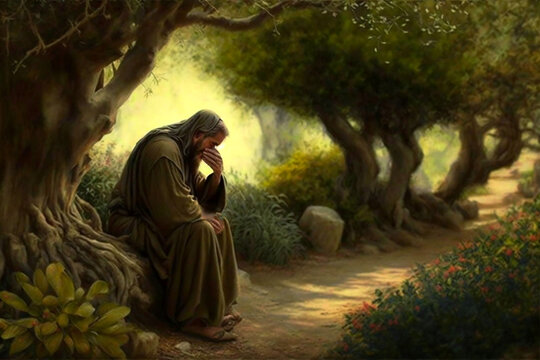
In the Garden
Do you remember that old hymn “In the Garden?” Where we come to the garden alone, with dew still on the roses? That song is a much beloved song of my sister and my brothers and I. It means a lot to us because it reminds us of our mother. She sang that song often as we were growing up. My mother was not a singer, but she sang anyway and I think we all inherited her and my dad’s love of music and music making.
That song has a particularly impactful memory for me. When I was a very small child, perhaps no more than four years old, I became quite sick, with a very high fever. I have no recollection of this event, and I never asked my mother what my ailment was, but her telling of this event has stayed with me. You see, when I was at my worst during this ailment, with my fever causing some delirium, I asked my mother to sing that song to me. I can only imagine the fright this must have given her because I’m sure she was afraid that I might be near death. Thankfully, I made a full recovery, but I’ve often wondered what that sick little girl, delirious with fever, was searching for in making that request of her mother.
Perhaps it was the words of the song which epitomize the fact that we can, in fact, come to Jesus at any time and ask for healing and comfort. The Bible mentions several gardens. Eden was a garden, so beautiful and perfect. God used the imagery of a well-watered garden when He inspired the prophets to describe His people when they were in perfect relationship with Him (Isaiah 58:11). Jeremiah 31:12 says “They shall come and sing aloud on the height of Zion, and they shall be radiant over the goodness of the Lord, over the grain, the wine, and the oil, and over the young of the flock and the herd; their life shall be like a well-watered garden, and they shall languish no more.” The word used for “languish” in this verse means to mourn, be sorrowful. I also love the word used for “garden” in this verse – it describes an enclosed garden.
In my imagination of the song, In the Garden, I always picture a pretty walled garden, with a nice low shade tree, and beautiful flowers all around with that lovely wall that keeps everything peaceful and calm inside, and everything wild and chaotic outside. And in my prayers, that’s where I meet with Jesus. Especially those times when I am really struggling with something. In my mind, I escape to that beautiful garden and I sit on the bench under that shade tree and Jesus sits with me, and He comforts me.
The Garden of Gethsemane was a place where Jesus often went, and on one fateful night, He also sought comfort from His Father. There was one final garden mentioned during the holy week of Jesus’ crucifixion and resurrection. John 19:41 tells us that near the place where Jesus was crucified there was a garden with a tomb that had never been used. We just celebrated Easter, that glorious day when Jesus defeated death and walked out of that tomb, alive and well. This last garden, the garden that contained the tomb with the stone that was rolled away, is what I like to call the Good News Garden. But this message isn’t about the Good News Garden or even the garden described in our beloved song.
Today, what’s on my heart involves the Garden of Gethsemane, or for our purposes today, the Garden of Decision.
On the eve of what was to be His arrest, Jesus went there with His disciples to pray (Mark 14:32). He went further into the garden with three of His closest disciples, but the last steps that went deepest into the garden, Jesus took alone. He had a decision to make, and it was a decision that couldn’t be made with a support group or a collective prayer meeting. He had to walk into the depths of the garden, and consider His choices. Yes, He was and is God, and He knew the end before the beginning (Isaiah 46:10). He knew what had to be done to save us all, and as God, He made that decision before the creation of the world (1 Peter 1:20). But this was Jesus, the man. He went to the garden as a human being, and the human being had a decision to make. How do we know this? Because the Bible tells us in Luke 22:41-44.
“He withdrew about a stone’s throw beyond them, knelt down and prayed,
“Father, if you are willing,
take this cup from me; yet not my will, but yours be done.”
An angel from heaven appeared to him and strengthened him.
And being in anguish, he prayed more earnestly, and his sweat
was like drops of blood falling to the ground.”
The word for “anguish” used in the verses above means a struggle; a struggle for victory; severe mental struggles and emotions, agony, anguish. He was in the Garden of Decision. His decision held the fate of humanity in His hands. With God all things are possible, and I fully believe that Jesus absolutely could have just turned His human volume down and His God volume up and gone to the cross without feeling an ounce of pain or stress or anything else. But He didn’t. He felt it fully and completely as a human being. Why?
Among other reasons, I believe that, as with every word that Jesus spoke and every action He took, He made this sojourn into the Garden of Decision to leave us with an example. An example of understanding because God knows that we are dust (Psalm 103:14) and that human decision-making can be extremely painful and difficult. But He also knows the way that we take (Job 23:10; Psalm 139:3) and He loves us with a love that our human minds and hearts can’t fully comprehend (Ephesians 3:19). In the fullness of His Deity, Jesus probably didn’t need the angel that appeared to Him to strengthen Him, but, as a human being, He did. And He knows that we do too. Jeremiah 8:18 says “You who are my Comforter in sorrow, my heart is faint within me.”
I think we have all come to a Garden of Decision at some point in our lives. Perhaps this finds you just at the edge of your own Garden of Decision and Jesus is calling you to go a stone’s throw away into the deep, into that Garden of Decision. Jesus came out the other side of his dark night of the soul into the Garden of Resolve. He was resolved to accept the task that He came to this earth to complete, and He did. His first steps were in that Good News Garden. We have the guarantee of an eternity in heaven because of His decision that night.
He now sits at the right hand of the Father, making intercession (Hebrews 7:25) for you and me in our own Garden of Decision. I know why I’m here, but what brings you to your Garden of Decision? What is it that is weighing on your heart and soul today? Is it to finally make that decision to accept Jesus as your Savior? Is it to surrender your life to the lordship of Christ? Is it that calling that is burning in your heart? Is it forgiveness that you know you need to extend? A cold heart that needs renewal? Maybe it’s to surrender your will to God’s will for your life whatever the cost or sacrifice?
The Bible doesn’t tell us what the angel said to Jesus, but whatever the words, Jesus then said “Not my will, but Yours be done.” Perhaps the angel reminded Jesus of who He was. Perhaps words were spoken about how much the Father loved Him. Perhaps He was reminded of you and me and what His sacrifice would mean for us and millions of others who are standing at our own Gardens of Decision.
I think what the Lord would have me to remind you today as you are standing in the middle of your own Garden of Decision is this:
“You are so loved”
“God sacrificed His only and only Son for you”
“Your name is engraved on the palm of His hand”
“Your decision will have a great impact”
“God will never leave you”
The path to your Good News Garden leads through the Garden of Resolve. May we find comfort and strength in our time of need in the same way that Jesus did, because now, He is sending the comfort, encouragement and strength to us today.
Proactive: Romans 8:32 – He who did not spare His own Son, but gave Him up for us all- how will He not also, along with Him, graciously give us all things?
Defensive: Jeremiah 8:18 – You who are my Comforter in sorrow, my heart is faint within me.
Promise: Joshua 1:5 – No one will be able to stand against you all the days of your life. As I was with Moses, so I will be with you; I will never leave you nor forsake you

 A Path Among the Rocks
Leave a reply to Caleb Cheruiyot Cancel reply